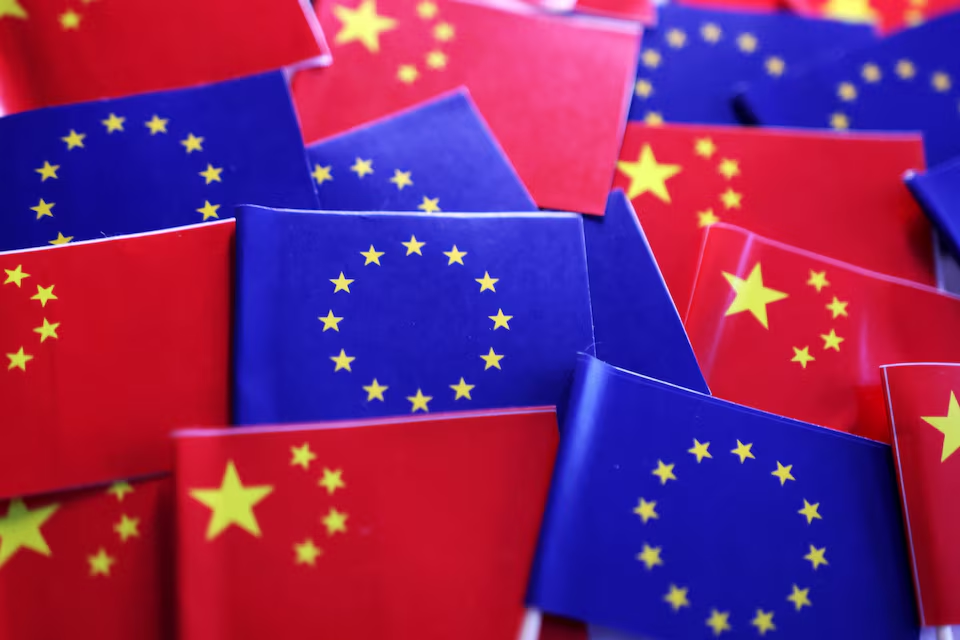
China has publicly urged the European Union to avoid actions that could damage the confidence of enterprises and dampen cross-border investment, as leadership in Beijing seeks to stabilise economic ties with Europe amid broader geopolitical tensions. In a statement released on January 19, senior Chinese economic officials emphasised the importance of maintaining a predictable and welcoming investment environment, a message they framed as essential for sustaining long-term cooperation between two of the world’s largest economic blocs.
The appeal comes against the backdrop of ongoing regulatory disputes and simmering trade tensions that have at times strained China-EU relations. Chinese authorities expressed concern that policy shifts perceived as restrictive or politically motivated could deter companies — both Chinese and European — from committing capital or expanding operations in each other’s markets. Officials outlined their position during a press briefing in Beijing, stressing that cooperation and mutual respect form the best foundation for stable economic engagement.
“Maintaining confidence among enterprises is critical,” a spokesperson for China’s Ministry of Commerce said, adding that negative signals from official policy could disproportionately affect decision-making across the private sector. The comments underscored Beijing’s desire to reassure international investors that China remains committed to an open economic strategy, even as global economic headwinds and geopolitical uncertainty complicate international business dynamics.
European diplomatic sources who spoke with Reuters acknowledged China’s concerns but reiterated that the EU must balance investment openness with regulatory standards related to national security, competition law, and strategic industries. Brussels has reportedly been reviewing foreign investment rules in sectors such as technology, telecommunications and critical infrastructure, drawing scrutiny from Chinese business leaders who fear tighter scrutiny might disadvantage their firms.
Analysts note that the appeal from Beijing is both economic and strategic. Europe remains one of China’s largest trading partners, and European companies operate extensive manufacturing, research, and distribution networks within China. Any deterioration in investor confidence could have ripple effects across supply chains and diminish both regions’ economic growth prospects at a time when global demand growth is slowing.
According to preliminary trade figures, bilateral flows between China and the EU continued to expand through 2025, albeit at a more modest pace than in previous years. This moderation has partly been attributed to weakening global demand, rising production costs, and competition from other regional markets. Nonetheless, many European firms list China among their top revenue drivers, particularly in automotive, luxury goods, and industrial machinery sectors.
Investors and corporate leaders are now watching how both sides will manage their regulatory and diplomatic dialogues in 2026. Some industry groups have welcomed China’s call for confidence-boosting measures but have also urged clarity around investment protections, intellectual property enforcement, and dispute resolution mechanisms. At the same time, European policymakers emphasise that any regulatory framework must ensure transparency and safeguard public interest without unnecessarily chilling foreign participation.
The broader context for these exchanges is one of shifting geopolitical alliances and economic realignments. China is deepening trade and investment ties with Southeast Asia, Africa, and the Middle East, while the EU continues to pursue diversified partnerships and regional trade agreements. In this environment, the language of reassurance and shared economic interest — such as China’s recent appeal — reflects an ongoing attempt by both sides to navigate competitive pressures while preserving the benefits of interconnected markets.