
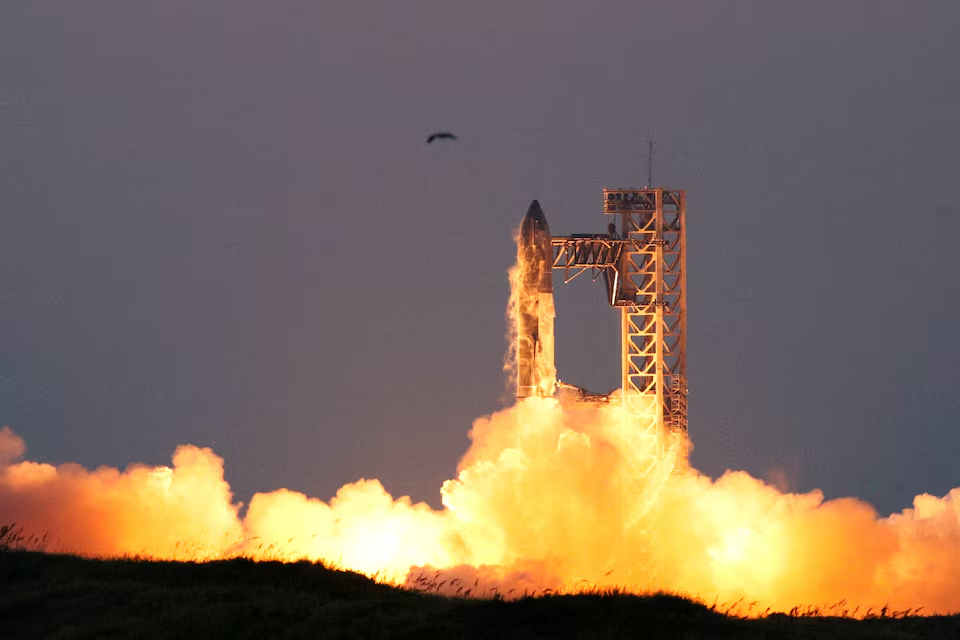
Investment in space technology is expected to climb again in 2026 following a record year in 2025, according to global investment data and industry forecasts shared by Reuters. Private capital flowing into space tech — including satellite communications, AI-integrated systems and launch infrastructure — surged to $12.4 billion in 2025, a 48% increase from the previous year, highlighting strong investor confidence in an emerging multi-sector frontier.
The growth in funding was led by the United States, which accounted for approximately $7.3 billion of total investment, buoyed by government policy prioritising space as a strategic economic and national security asset. The Pentagon’s Golden Dome initiative, aimed at strengthening satellite and defense infrastructure, was cited by analysts as a significant catalyst for capital inflows.
Beyond defense, private sector enthusiasm is growing for space technologies tied to communications, Earth observation and data analytics. The integration of artificial intelligence (AI) into satellite systems and space hardware is seen as a key differentiator for investors, enabling enhanced performance, autonomous operations and advanced analytics capabilities across orbital platforms.
Another potential boost for the space sector could come from high-profile public offerings. Analysts believe that a possible initial public offering (IPO) from major players such as SpaceX could validate space tech as a mainstream investment category and attract broader institutional capital. Such a move would mirror historical tech booms, where marquee listings opened the market to a wider range of investors.
Geographically, while the U.S. dominates investment flows, Europe and China also showed robust activity, with China contributing around $2 billion in funding and expanding its domestic manufacturing and launch capabilities. This reflects a broader global competition to capture leadership in the satellite and space tech markets, with national programs, private capital, and strategic partnerships shaping the trajectory of this high-growth sector.
Industry experts say that as space becomes more integral to communications, defense, and scientific research, investment patterns are likely to diversify further. This transition aligns with longer-term trends where space infrastructure is no longer a niche segment, but a cornerstone of national strategy and commercial opportunity.